
Massage Therapist Certification in India 2026: Which One to Choose?
Compare certifications by cost, duration, recognition, and career impact
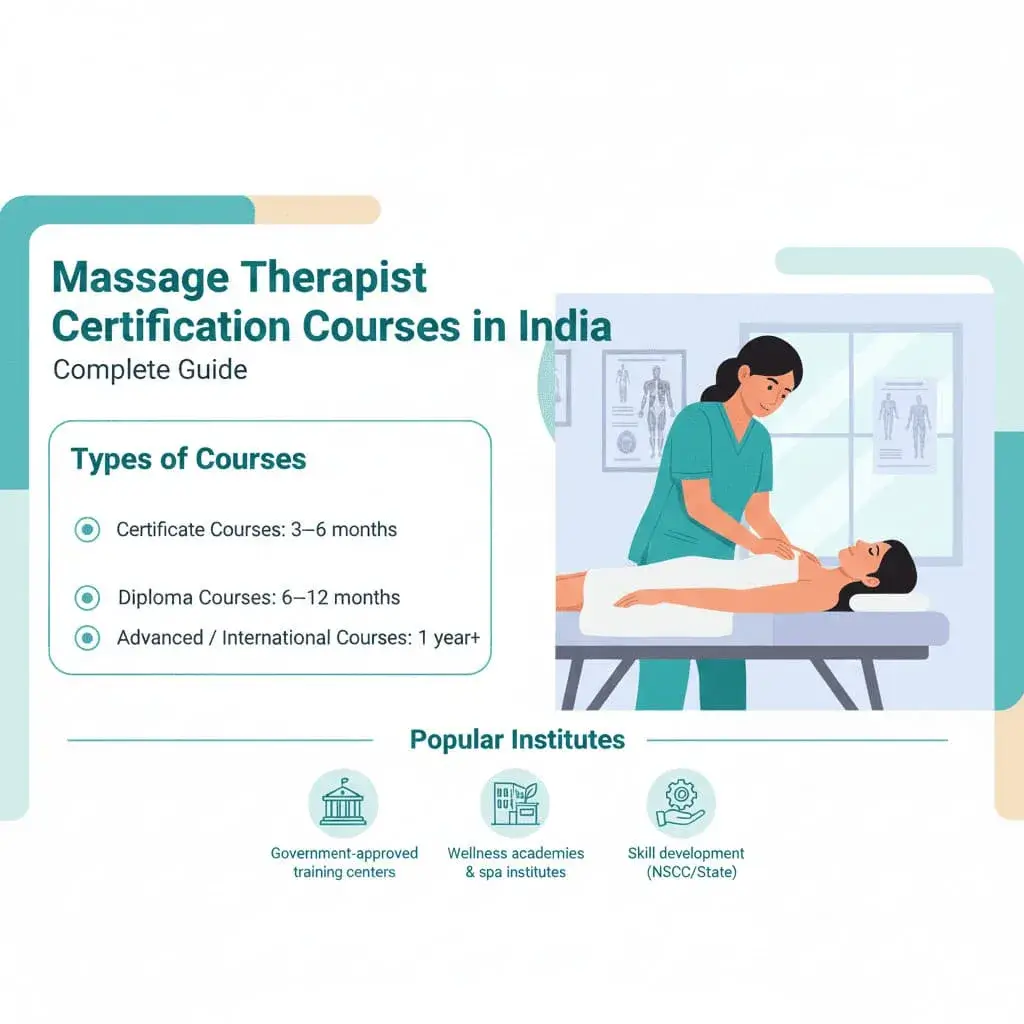
Choosing the right massage therapy certification is one of the most important career decisions you will make. The certification you hold directly impacts your starting salary, job opportunities, client perception, and long-term earning potential. With dozens of options available in India, from weekend workshops to year-long international diplomas, making the right choice requires understanding what each certification actually offers.
This guide provides an objective comparison of massage therapy certifications available in India, helping you choose based on your specific career goals, budget, and timeline.
Understanding the Certification Landscape
Massage therapy certifications in India fall into three broad categories, each serving different career paths and offering different levels of recognition:
1. International Certifications
Globally recognized qualifications from international awarding bodies. These carry the highest prestige and open doors to luxury hospitality, cruise ships, and international opportunities.
- CIBTAC (Confederation of International Beauty Therapy and Cosmetology)
- CIDESCO (Comité International d'Esthétique et de Cosmétologie)
- VTCT (Vocational Training Charitable Trust)
- ITEC (International Therapy Examination Council)
- City & Guilds qualifications
2. Indian Government-Recognized Certifications
Qualifications from Indian boards and councils that are recognized domestically and valued by Indian employers.
- NSDC (National Skill Development Corporation) certifications
- State technical board diplomas
- University-affiliated programs
- AYUSH-recognized Ayurvedic therapy certifications
- Government ITI (Industrial Training Institute) courses
3. Private Institute Certifications
Training from private academies and spa chains. Quality varies significantly; some are excellent, others offer minimal training.
- Spa chain training academies (Tattva, O2, etc.)
- Private beauty and wellness institutes
- Hotel chain training programs
- Independent massage schools
International Certifications: Detailed Comparison
CIBTAC (Most Popular in India)
CIBTAC is the most widely recognized international certification in India's spa and wellness industry. Most luxury hotels and premium spas specifically require or prefer CIBTAC-certified therapists.
| Aspect | Details |
|---|---|
| Duration | 3-6 months (full-time) / 6-12 months (part-time) |
| Cost Range | ₹80,000 - ₹2,00,000 |
| Key Modules | Anatomy, Swedish massage, aromatherapy, body treatments |
| Recognition | Global - accepted in 40+ countries |
| Best For | Luxury hospitality, international careers |
| Exam Format | Theory + practical assessment by external examiner |
- ✓Highly valued by 5-star hotels and luxury spas
- ✓Recognized for international job applications
- ✓Comprehensive curriculum covering multiple modalities
- ✓Strong emphasis on anatomy and physiology
- ✓External assessment ensures quality standards
CIDESCO (Premium International Standard)
CIDESCO is considered the gold standard in beauty and spa therapy education globally. It offers the most comprehensive training but requires significant time and financial investment.
| Aspect | Details |
|---|---|
| Duration | 12-18 months (full diploma) |
| Cost Range | ₹1,50,000 - ₹4,00,000 |
| Key Modules | Comprehensive spa therapy, aesthetics, business management |
| Recognition | Highest global recognition - 40+ countries |
| Best For | Spa management, international luxury brands |
| Exam Format | Rigorous theory + practical + case studies |
- ✓Highest prestige in the industry
- ✓Opens doors to spa management roles
- ✓Most comprehensive curriculum available
- ✓Strong focus on business and client management
- ✓Best for long-term career in luxury wellness
VTCT (UK Vocational Qualifications)
VTCT offers UK-regulated vocational qualifications recognized across Europe and Commonwealth countries. Increasingly available in India through partner institutes.
| Aspect | Details |
|---|---|
| Duration | 3-9 months depending on level |
| Cost Range | ₹60,000 - ₹1,50,000 |
| Key Modules | Level-based progression from basic to advanced |
| Recognition | UK/Europe focused, growing Indian acceptance |
| Best For | UK/Europe career plans, structured learning |
| Exam Format | Continuous assessment + final practical |
ITEC (International Therapy Examination Council)
ITEC offers internationally recognized qualifications with a strong focus on complementary therapies. Good option for those interested in therapeutic rather than spa-focused massage.
| Aspect | Details |
|---|---|
| Duration | 3-6 months per qualification |
| Cost Range | ₹50,000 - ₹1,20,000 |
| Key Modules | Holistic therapies, anatomy, specific techniques |
| Recognition | Global - strong in therapeutic settings |
| Best For | Clinical massage, wellness centers |
| Exam Format | Theory + practical examination |
Indian Certifications: Value Options
NSDC (National Skill Development Corporation)
Government-backed skill certification under the Skill India initiative. Affordable and increasingly recognized by Indian employers, though not internationally portable.
| Aspect | Details |
|---|---|
| Duration | 2-6 months |
| Cost Range | ₹15,000 - ₹50,000 (subsidies available) |
| Key Modules | Basic massage, spa operations, customer service |
| Recognition | India-wide, growing employer acceptance |
| Best For | Budget-conscious learners, domestic careers |
| Exam Format | Skill assessment by certified assessors |
Ayurvedic Therapy Certifications
For those interested in traditional Indian massage modalities, AYUSH-recognized certifications in Ayurvedic therapies offer unique specialization opportunities with strong market demand.
- Panchakarma therapy certification (6-12 months)
- Ayurvedic massage specialist courses (3-6 months)
- Kerala traditional therapy programs
- Recognized by wellness tourism sector
- Strong demand from international wellness tourists
Complete Certification Comparison
| Certification | Cost | Duration | Salary Impact | Best For |
|---|---|---|---|---|
| CIDESCO | ₹1.5L-4L | 12-18 months | +60-100% | Luxury/Management |
| CIBTAC | ₹80K-2L | 3-6 months | +40-70% | Luxury Hospitality |
| VTCT | ₹60K-1.5L | 3-9 months | +30-50% | UK/Europe careers |
| ITEC | ₹50K-1.2L | 3-6 months | +30-50% | Clinical/Therapeutic |
| NSDC | ₹15K-50K | 2-6 months | +10-20% | Entry-level India |
| Private Institute | ₹20K-80K | 1-6 months | Variable | Quick start |
How to Choose: Decision Framework
Choose CIBTAC If:
- ✓You want to work in luxury hotels or premium spas in India
- ✓You have ₹1-2 lakh budget and 3-6 months available
- ✓International recognition matters but India is primary focus
- ✓You want the best balance of cost, time, and career impact
- ✓International work opportunities (cruise ships, Middle East) interest you
Choose CIDESCO If:
- ✓You aim for spa management or leadership roles
- ✓Budget of ₹2-4 lakh and 12-18 months is feasible
- ✓You want the highest possible industry recognition
- ✓Long-term career in luxury wellness is your goal
- ✓You plan to eventually open your own spa
Choose NSDC/Indian Certification If:
- ✓Budget is limited (under ₹50,000)
- ✓You need to start earning quickly
- ✓Domestic career in India is your primary focus
- ✓You plan to upgrade to premium certifications later
- ✓Government PMKVY subsidies are available to you
Choose Ayurvedic Certification If:
- ✓Traditional Indian therapies genuinely interest you
- ✓You want to work in wellness tourism or Ayurvedic resorts
- ✓Kerala or wellness retreat centers are target employers
- ✓You want a unique specialization in the market
- ✓International wellness tourists are target clientele
Where to Get Certified: Top Training Institutes
Mumbai
- VLCC Institute - CIBTAC, CIDESCO programs
- Lakme Academy - Multiple certification options
- Shahnaz Husain Group - Beauty and spa therapy
- Orane International - CIBTAC certified center
Delhi NCR
- VLCC Institute Gurugram - Full range of certifications
- Meribindiya International Academy - CIDESCO, CIBTAC
- Pearl Academy - Spa management programs
- ISAS (International Spa Association School)
Bangalore
- VLCC Institute - CIBTAC programs
- Looks Salon Academy - Multiple certifications
- Ananda Spa Institute - Ayurvedic specializations
- Various NSDC-affiliated training centers
Kerala (Ayurvedic Specialization)
- AVP (Arya Vaidya Pharmacy) Academy
- Kottakkal Ayurveda training programs
- Government Ayurveda colleges
- Traditional Kalari and therapy schools
What to Expect: Curriculum Overview
Quality massage therapy certifications cover comprehensive curricula. Here is what standard international certifications include:
Theory Components
- Anatomy and physiology (skeletal, muscular, circulatory systems)
- Skin science and contraindications
- Health and safety regulations
- Client consultation and assessment
- Business and professional ethics
- Treatment planning and documentation
Practical Components
- Swedish/Western massage techniques
- Deep tissue and sports massage basics
- Aromatherapy and reflexology application
- Body wraps and exfoliation treatments
- Hot stone therapy in advanced programs
- Client handling and draping techniques
Assessment Methods
- Written theory examinations
- Practical demonstrations on live models
- Case study presentations
- Client consultation role-plays
- Portfolio of treatments performed
- External examiner assessment (for international certifications)
Return on Investment: Is Expensive Certification Worth It?
The financial case for premium certifications is compelling when you calculate long-term earning potential:
| Certification | Cost | Starting Salary | 5-Year Earnings | ROI |
|---|---|---|---|---|
| No Certification | ₹0 | ₹15K/month | ₹9L | Baseline |
| NSDC Basic | ₹30K | ₹18K/month | ₹10.8L | 3,400%+ |
| CIBTAC | ₹1.5L | ₹30K/month | ₹18L | 1000%+ |
| CIDESCO | ₹3L | ₹40K/month | ₹24L | 700%+ |
These calculations assume steady employment and do not account for faster promotions and higher tips that certified therapists typically receive. The actual ROI for premium certifications is often higher.
Common Mistakes to Avoid
- Choosing based on cost alone: Cheapest options often provide least value
- Ignoring practical hours: Theory-heavy courses produce unprepared graduates
- Not verifying accreditation: Unaccredited certificates have no industry value
- Skipping anatomy modules: Understanding the body is fundamental to safe practice
- Rushing through programs: Accelerated courses often sacrifice depth
- Neglecting business skills: Client management is as important as technique
- Not researching employer requirements: Know what your target employers actually want
Continuing Education: Beyond Initial Certification
Your initial certification is just the beginning. Successful therapists continuously add specializations to increase earning potential:
- Advanced modalities: Thai massage, Shiatsu, couples massage
- Specialized populations: Prenatal, geriatric, sports massage
- Complementary therapies: Reflexology, aromatherapy advanced
- Management certifications: For career progression to spa management
- Teaching qualifications: To become a trainer or assessor
Frequently Asked Questions
Can I work as a massage therapist without certification?
Which certification do 5-star hotels prefer?
Can I get certified online?
How long does certification take?
Is CIBTAC or CIDESCO better?
Do I need separate certifications for different massage types?
Can I upgrade from basic to advanced certification?
Start Your Certification Journey
The right certification opens doors to rewarding career opportunities in massage therapy. Whether you choose an intensive international program or start with affordable domestic certification, taking that first step matters most.
Research programs carefully, verify accreditation, and choose based on your specific career goals. The investment in quality training pays dividends throughout your career in higher earnings, better opportunities, and professional satisfaction.
Related Articles
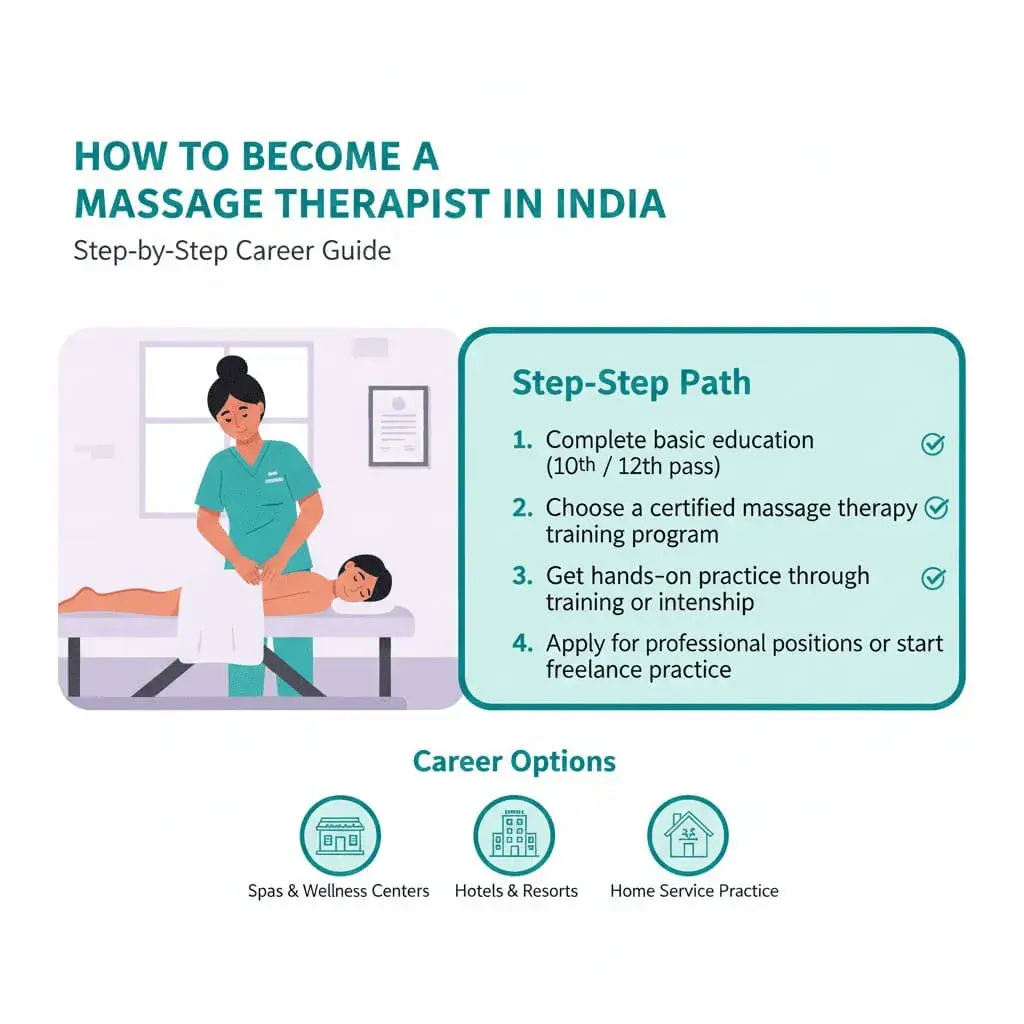
How to Become a Massage Therapist in India 2026: Career Guide
How to become a massage therapist in India. Training programs, certifications, costs, job opportunities, and a step-by-step career pathway explained.
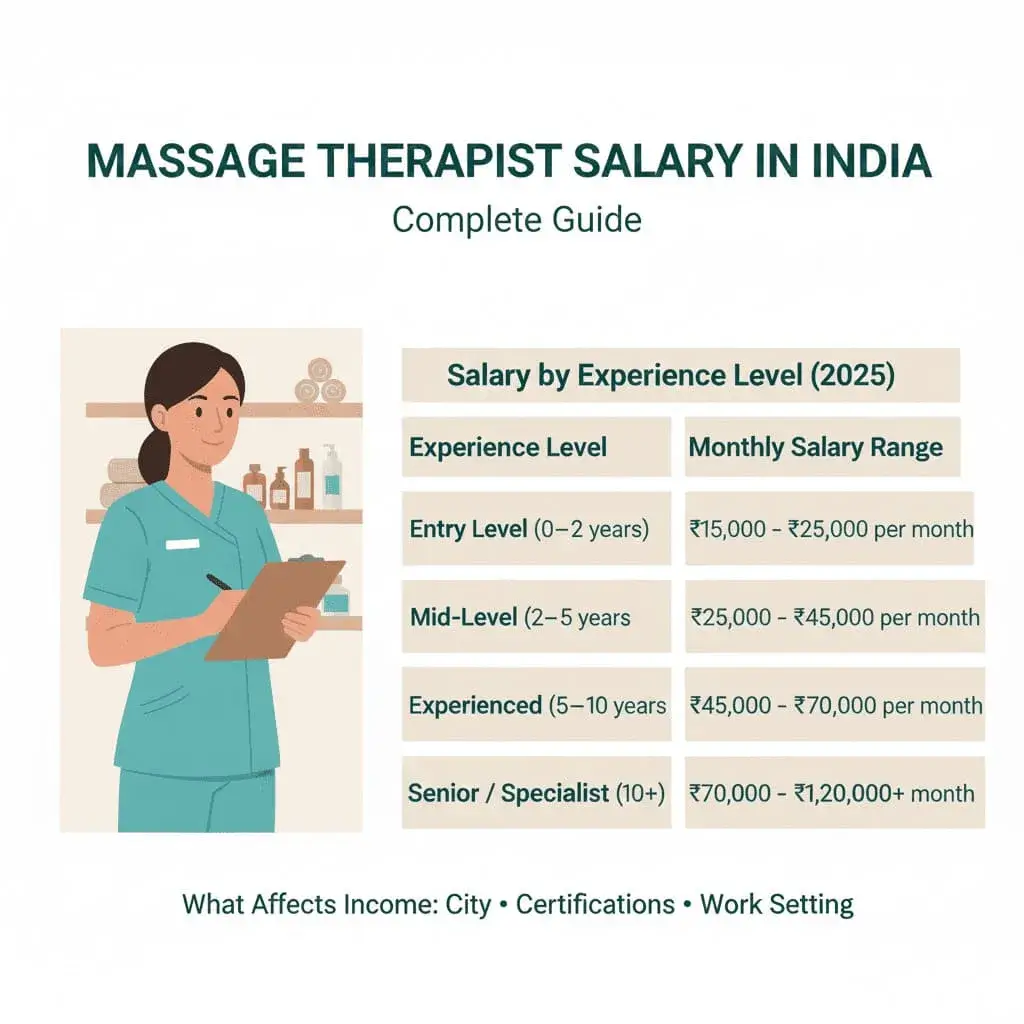
Massage Therapist Salary in India 2026: Complete Guide
Massage therapist salary guide for India 2026. Compare earnings by city, experience level, and work setting. Tips to maximize your earning potential.
Massage Services in Other Cities

Professional Home Massage in Mumbai
Professional home massage in Mumbai. {{therapist_count}}+ verified therapists, same-day booking, 40+ areas covered. Swedish, deep tissue & Thai massage. Book now.

Professional Home Massage in Delhi NCR
Professional home massage in Delhi NCR. {{therapist_count}}+ verified therapists offering same-day booking across 50+ areas including Gurgaon, Noida, and CP. Book now.

Professional Home Massage in Bangalore
Professional home massage in Bangalore. {{therapist_count}}+ verified therapists, same-day booking across 50+ areas. Koramangala, Whitefield, HSR Layout. Book now.
Professional Home Massage in Pune
Professional home massage in Pune. {{therapist_count}}+ verified therapists offering same-day booking across 40+ areas. Koregaon Park, Baner, Hinjewadi. Book now.